
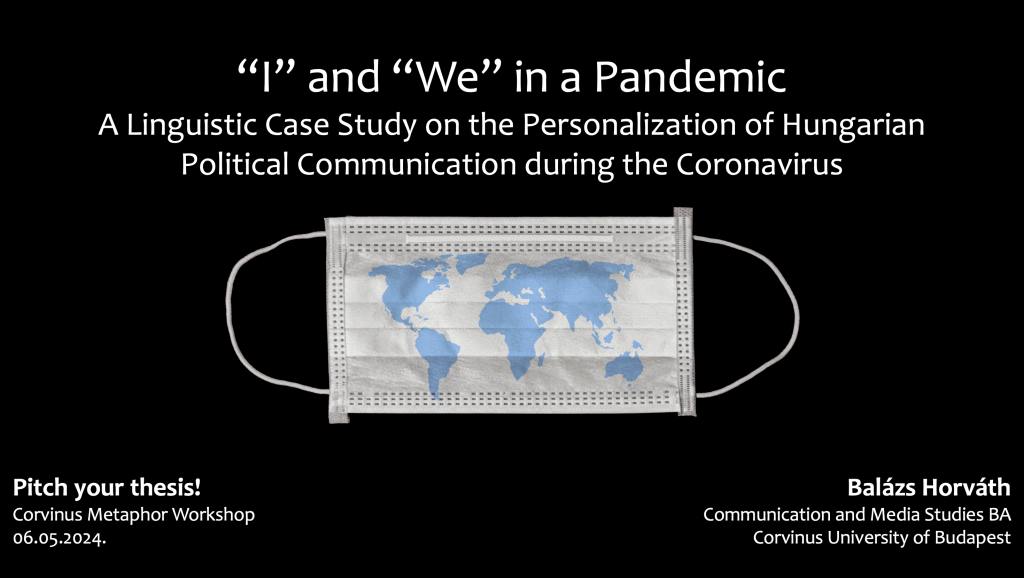
🇬🇧 A linguistic case study on the personalization of Hungarian political communication during the coronavirus
Author: Balázs Horváth
As politicians increasingly share personal content and information about themselves, the importance of political collectives – such as political parties – is diminished. This phenomenon can also be observed in the Hungarian political discourse, including social media and television. During the Covid-19 outbreak, the stakes of Hungarian political communication were even higher. This was due to the necessity of addressing the question of the existence of the rule of law, the government’s incitement of public opinion, for example through the creation of enemies, the identification of the virus with war metaphors, or the one-sided and limited government communication.
What were the tendencies in the personalization of political communication during the coronavirus pandemic? My research sought to answer this question through an analysis of transcripts of interviews given by the Hungarian Prime Minister to Kossuth Radio between 2020 and 2021, during the first three “waves” of the coronavirus. Using corpus linguistics methods, I examined the use of first-person singular (1PS) and first-person plural (1PP) pronouns and other possessive markers. This method allowed me to quantify the degree of personalization versus collective representation in the Prime Minister’s rhetoric.
In the case of 1PS, an upward-downward trend is apparent, while for 1PP an opposite curve is observed during the first three “waves” of the coronavirus. The use of first-person plural pronouns outnumbered the first-person singular pronouns, with the former representing 63.2% and the latter 36.8%. This indicates a predominant inclination towards collective representation. There was only one radio interview in which 1PS was used more frequently than 1PP. This can be explained by the Prime Minister’s attempt to deflect responsibility from 1PS (himself) to 1PP (in this case the party).
With regard to first-person plural possessive markers, the statement can be made on behalf of several groups, which in my thesis can refer to family, party, nation, nations, European Union and humanity. The frequency of references to family, party, and humanity subcategories decreased, while those to nation, nations and the EU increased.
From the very beginning, families played a central role in their communication. It is interesting to note that the proportion of people speaking on behalf of their own family in the corpus during the coronavirus was negligible. This discrepancy can be explained by the fact that during the Covid-19 outbreak, the PM focused on his party and the nation rather than his own family. It may be counterproductive too to speak of the latter at a time when community distancing rules were in place. Furthermore, it may serve a “hiding” function to deliberately say little on their behalf.
The number of references to the European Union has increased, presumably because Hungary required the support of the 27 Member States to join forces, both financially and politically.
Read more here (in Hungarian):
Horváth, B. (2024, in press). „Én” és „mi” egy világjárványban: Nyelvészeti esettanulmány a magyar politikai kommunikáció perszonalizációjáról a koronavírus idején. Budapesti Corvinus Egyetem, Marketing- és Kommunikációtudományi Intézet.
(Supported by the ÚNKP-23-1-I-CORVINUS-47. New National Excellence Program of the Ministry for Culture and Innovation from the source of the National Research, Development and Innovation Fund.)
_______________________________________________________________________________________
„Én” vagy „mi” egy világjárványban?
🇭🇺 Nyelvészeti esettanulmány a magyar politikai kommunikáció perszonalizációjáról a koronavírus idején
Szerző: Horváth Balázs
A politikusok az idő előrehaladtával egyre személyesebb tartalmakat és információkat osztanak meg magukról, amellyel egy időben csökken a politikai kollektívák – így a pártok – jelentősége is. A jelenség megfigyelhető a magyar politikai színtéren is, többek között a közösségi médiában és a televízióban. A Covid19-járvány alatt a hazai politikai kommunikációnak még nagyobb tétje volt: ide sorolhatjuk a jogállamiság meglétének kérdését, a kormány hangulatkeltését például az ellenségkreáláson keresztül, a vírus háborús metaforákkal való azonosítását vagy az egyoldalú, korlátozott kormányzati kommunikációt is.
Milyen tendenciák mutatkoztak a politikai kommunikáció perszonalizációjában a koronavírus-járvány idején? Kutatásom erre a kérdésre kereste a választ a magyar miniszterelnök által a Kossuth Rádiónak adott interjúk szöveges leiratain keresztül 2020 és 2021 között, tehát a koronavírus első három „hulláma” idején. A tanulmány az igei személyragok, birtokos személyjelek és személyes névmások első személyű eseteinek használatát vizsgálta korpusznyelvészeti módszerrel, amely lehetőséget biztosított az egyes és többes számra vonatkozó adatok számszerű kimutatására. Előbbi egyértelműen a perszonalizációt mutatja, míg utóbbi valamely csoport nevében való megnyilatkozásra utal, azaz kevésbé perszonalizált. A T/1 esetén ráadásul többféle csoport nevében is történhet a nyilatkozat, ezek jelen kutatásban a családra, pártra, nemzetre, nemzetközösségre, Európai Unióra és az emberiségre utalást jelenthetik.
Az E/1 személyjelölések száma nem haladta meg a T/1 utalásokét, ugyanis ezer szóra normalizált szummájuk 63,2 százalékát teszik ki a többes számúak, míg 36,8 százalékát az egyes számúak. Az E/1 esetében egy növekvő-leszálló tendencia látszik, míg a T/1-nél egy ezzel ellentétes görbe rajzolódik ki a koronavírus első három „hulláma” alatt. Mindössze egy olyan rádióinterjú volt, amelyben az E/1 használata gyakoribb volt, mint a T/1-é. Ez vélhetően azzal magyarázható, hogy a miniszterelnök megpróbálja a felelősséget E/1-ről (saját magáról) T/1-re (jelen esetben a pártra) hárítani.
A többes szám alkategóriáiban a családra, pártra és az emberiségre utaló személyjelölések gyakorisága csökkent, míg a nemzet, nemzetközösség és az Európai Unió esetén növekedés volt megfigyelhető.
Kommunikációjukban már a kezdetektől központi szerepet kapott a család, ennek fényében érdekes, hogy elenyésző arányban jelent meg a saját család nevében való megszólalás a korpuszban a koronavírus alatt. Ez az ellentmondás vélhetően azzal magyarázható, hogy a Covid19-járvány alatt inkább a pártjára és a nemzetre helyezte a hangsúlyt, mintsem a saját családjára, ugyanis kontraproduktív lehet utóbbiról beszélni egy olyan időszakban, amikor közösségi távolságtartási szabályok voltak érvényben. „Rejtőzködési” funkciót is betölthet, hogy szándékosan keveset nyilatkozik a nevükben.
Az Európai Uniós utalások száma megemelkedett vélhetően annak okán, hogy Magyarországnak szüksége volt a 27 tagállamos összefogás támogatására mind pénzügyileg, mind politikailag.
A kutatásról bővebben itt lehet olvasni:
Horváth, B. (2024, in press). „Én” és „mi” egy világjárványban: Nyelvészeti esettanulmány a magyar politikai kommunikáció perszonalizációjáról a koronavírus idején. Budapesti Corvinus Egyetem, Marketing- és Kommunikációtudományi Intézet.
(A Kulturális és Innovációs Minisztérium ÚNKP-23-1-I-CORVINUS-47. kódszámú Új Nemzeti Kiválóság Programjának a Nemzeti Kutatási, Fejlesztési és Innovációs Alapból finanszírozott szakmai támogatásával készült.)
 Corvinus Metaphor Workshop