
Author: Kundyz Mukhangali
MetCommS members presented at the Culture and Cognition in Language conference in Poland
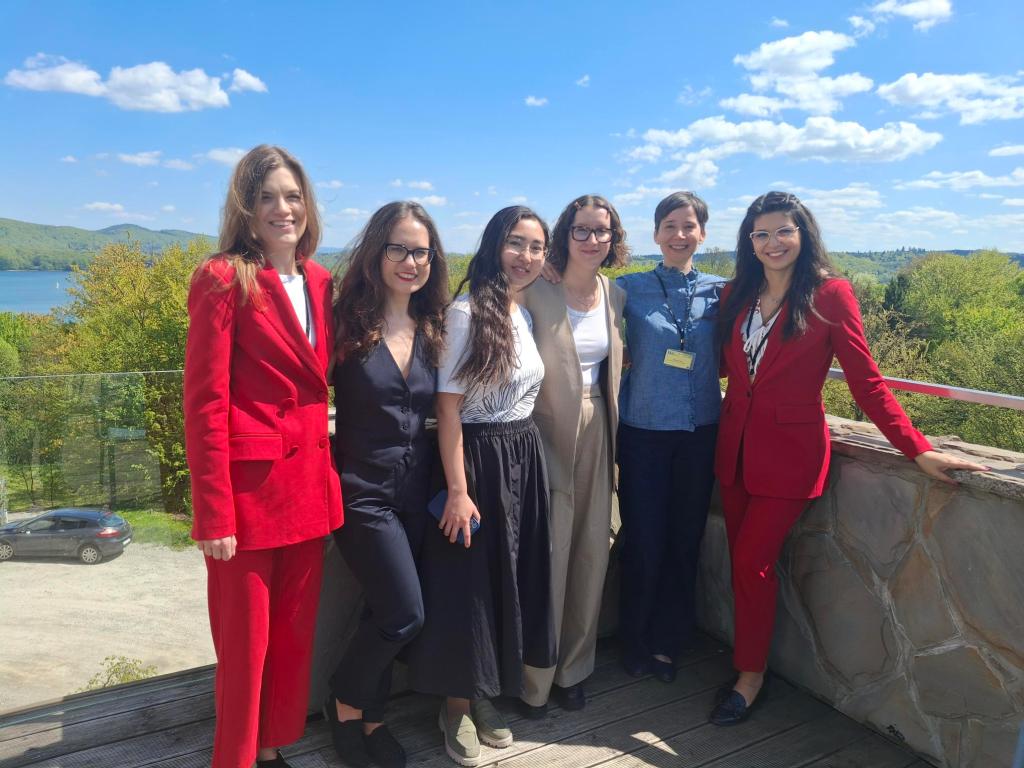
At the end of April, six members of MetCommS (Metaphor in Communication and Society Research Lab) attended the Culture and Cognition in Language: CCL 4 conference in Polańczyk, Poland. Our members had a unique opportunity to share their research findings with leading cognitive linguists and communication experts from across Europe. Their topics ranged from health to political communication. In this blog, we shed light on their presentations and share some of their experiences and insights from the conference.
First-year PhD student Dóra Eszter Varga shared her reflections on her first international conference experience:
“I received a wealth of insightful feedback and suggestions from my teachers and peers, and I engaged in fascinating discussions with them. For instance, Prof. Christopher Hart from Lancaster University recommended books and methods on multimodality that I could incorporate into my future research.”
Dóra’s research explores a highly timely topic in Hungarian public discourse, especially in light of the upcoming 2026 parliamentary elections. She focuses on the election communication of Péter Magyar, a leading political figure, during his 2024 campaign. She finds that the conceptual metaphor LIFE IS A STRUGGLE/WAR, which is dominant in Hungarian public discourse, appeared less frequently in Magyar’s campaign, whereas POLITICS IS STRUGGLE/WAR was the most prevalent:
“These findings reveal an intriguing insight: while both the domains of politics and life can be conceptualized through various source domains, in this sample, they both employ only the struggle/war source domain. It is plausible that Hungarian citizens find this metaphorical conceptualization more relatable than, for instance, the politics is business metaphor, which is more characteristic of American politics. This may explain why Magyar’s communication resonated so effectively with Hungarians.”
Moreover, Dóra hypothesizes that Magyar’s frequent references to the Hungarian Revolution and War of Independence of 1848-1849 also contributed to the success of his political communication. She plans to expand her current research with a multimodal analysis, which may reveal even more fascinating insights into the complex and multifaceted language of politicians.
Second-year PhD student Kundyz Mukhangali shared her preliminary research on Russian-Kazakh relations as reflected in Kazakhstani news media. She collected data from three leading Kazakhstani outlets, focusing on two key events: the January 2022 protests (major protests in Kazakhstan) and the beginning of the Russo-Ukrainian war:
“This conference was unique for me because of its central focus on linguistics-related topics and methods. Coming from a journalism, and more broadly from media studies, I was both worried and excited to present my study in front of cognitive linguists and other professionals in the field. However, this experience brought positive light on my broader PhD project, revealing potential new angles and requiring deeper analysis of media language.”
Kundyz also plans to expand her dataset and explore metaphorical expressions in the lesser-researched Kazakh language, alongside Russian-language Kazakhstani media.
Her colleague and fellow PhD student Petra Bialkó-Marol presented a pilot study from her doctoral research, examining how Hungarian women discuss infertility in online forums. She focused on the metaphors used to express this often-taboo experience, revealing how women make sense of the emotional and social challenges of infertility – from diagnosis to treatment. Her goal is to better understand these often-hidden narratives.
Réka Benczes, Alexandra Nagy-Béni, and Lilla Petronella Szabó also presented their recent findings. Réka Benczes, Professor of Linguistics, shared her research on metaphorical conceptualizations of breast cancer among Hungarian patients, based on data from an online survey distributed to individuals diagnosed with the illness.
The joint research of Alexandra Nagy-Béni and Réka Benczes addressed a less explored topic in communication studies: the visual representation of older women in Hungarian media discourse. Combining visual discourse analysis and conceptual metonymy-based image analysis, their study highlights the presence of gendered ageism in mainstream media. These portrayals, in turn, contribute to broader societal perceptions of ageing in Hungary. Their findings indicate the importance of media responsibility and ethics in (re)producing the gendered stereotypes in ageing societies.
Finally, Lilla Petronella Szabó examined the intricacies of political communication in the speeches of Hungarian Prime Minister Viktor Orbán. This time, she focused on the metonymic use of “East” and “West” in his rhetoric over the past 15 years. Her findings show that Hungary’s position in this East-West framework is portrayed as flexible and dynamic: in some cases, Hungary is depicted as part of the West, while in others, its alignment with the West is more ambiguous. Thus, metonymic conceptualization becomes a rhetorical tool to demonstrate the flexible nature of contemporary Hungarian political discourse.
The conference was organized by the Institute of English Studies at the University of Rzeszów. This year’s Culture and Cognition in Language: CCL 4 conference focused on language as both a cultural and cognitive phenomenon, with leading themes including power, identity, health, and the natural world.
 Corvinus Metaphor Workshop